
Executive Summary
Commercial toll enforcement requires more than license plate recognition alone. Plates identify vehicles, but repeat commercial toll abuse often happens at the carrier or operator level across multiple trucks, plates, trailers, accounts, and registrations.
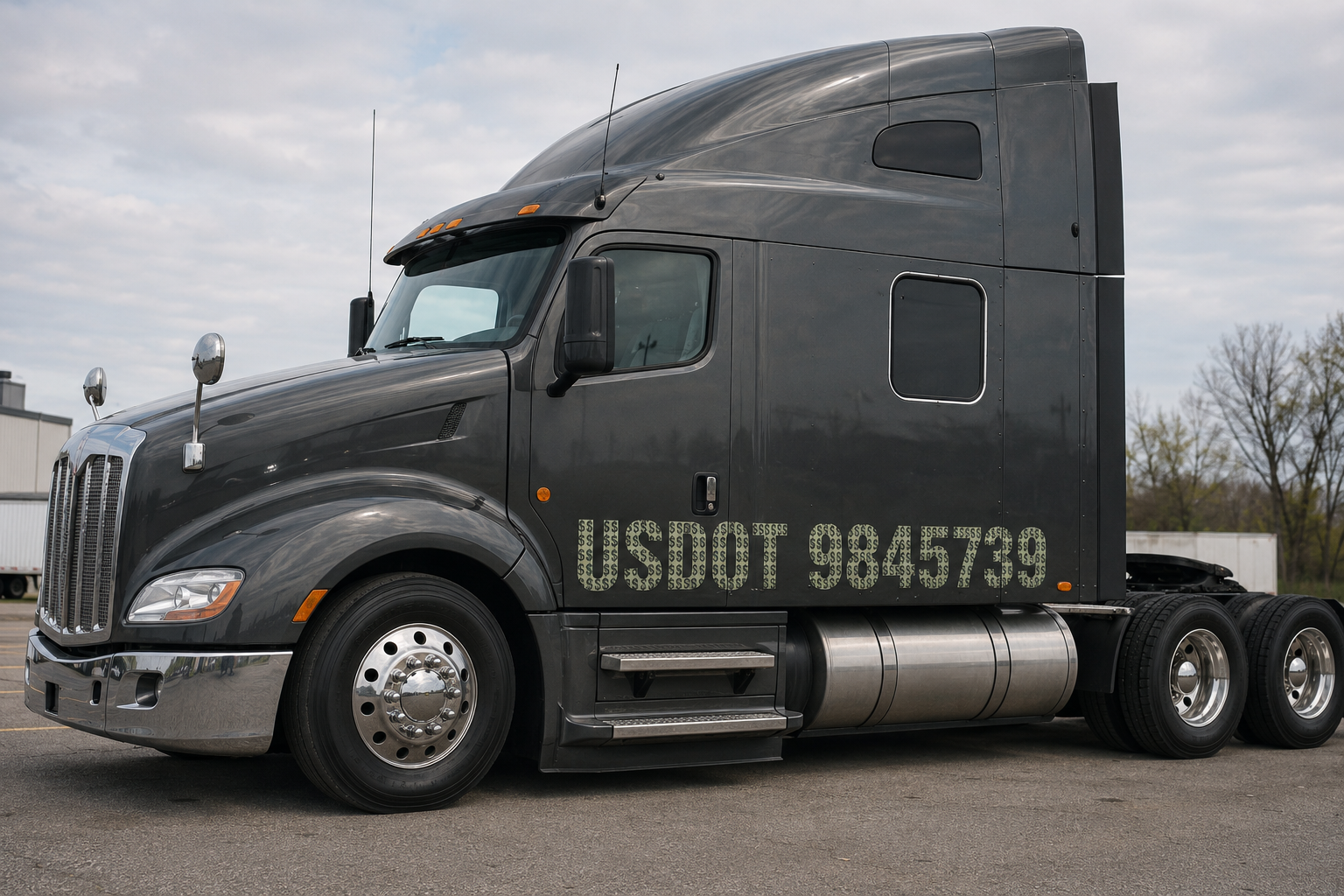
USDOT number capture gives toll authorities an additional identity layer. When paired with ALPR, RFID status, vehicle classification, timestamps, lane metadata, and image evidence, USDOT capture can help toll roads identify repeat commercial violators, build carrier-level enforcement records, and support authorized action when the vehicle is physically present on the facility.
USDOT recognition does not replace ALPR. It strengthens it by connecting the truck in the lane to the commercial operator behind the trip.
Why Commercial Vehicle Toll Enforcement Requires a Different Strategy
Commercial trucks are not just another vehicle class on a toll road. They are often a disproportionately large share of toll revenue.
A passenger car may pay a few dollars for a trip. A five-axle tractor-trailer may pay many times that amount. On some toll systems, commercial vehicles represent a relatively small share of total traffic, but a very large share of revenue. The New York State Thruway’s 2024 traffic and revenue materials show commercial vehicles representing only a minority of systemwide transactions while producing a much larger share of toll revenue. Maryland’s toll system has reported commercial vehicles accounting for roughly half of gross toll revenue. Pennsylvania Turnpike rating materials have similarly reported commercial vehicles at about 17% of traffic but 48% of total revenues.
That revenue concentration creates a simple enforcement reality: when commercial fleets pay, the system works. When persistent commercial violators do not pay, the loss can be much more significant than ordinary passenger-car leakage.
Most trucking companies are legitimate operators. They use transponders, maintain accounts, and treat tolls as part of the cost of doing business. But a small number of repeat commercial toll violators can create losses far out of proportion to their number. Publicly reported enforcement and collection cases show some commercial operators owing tens of thousands, hundreds of thousands, and in some cases more than half a million dollars in unpaid tolls and fees.
For toll authorities, the lesson is clear: high-value commercial toll abuse is not only a billing problem. At the serious-repeat-violator level, it becomes an identity, enforcement, and asset-control problem.
How Truck Toll Revenue Drives Toll Road Financial Performance
Truck tolls matter because commercial vehicles are priced differently from passenger vehicles. A heavy commercial truck may be charged many times more than a two-axle passenger car for the same corridor. That is logical: trucks place greater demands on road infrastructure, occupy more lane space, and are often charged by axle count, weight class, or vehicle classification.
The result is that a relatively small number of commercial vehicles can produce a very large share of system revenue. For toll operators, this makes commercial account compliance a financial priority. A passenger car that avoids one toll may create a small collection issue. A commercial fleet that repeatedly avoids tolls can create a significant revenue-protection problem.
This is why commercial toll enforcement requires more than ordinary violation processing. The higher the toll value per trip, the greater the financial impact of repeat nonpayment. The enforcement system must be able to identify not only the vehicle in the lane, but the commercial operator behind the vehicle.
The Two-Stage Nature of Commercial Toll Evasion: Capture Avoidance and Nonpayment
Commercial toll evasion often happens in two stages.
The first stage is capture evasion. The goal is to prevent the toll system from reliably identifying the vehicle at the point of use. Methods may include missing, unreadable, improperly mounted, or deliberately misused transponders; obscured license plates; dirty or damaged plates; plate covers; temporary tags; fake tags; missing plates; or other tactics that make automatic identification more difficult.
The second stage is collection evasion. Even when a vehicle is captured and an invoice or violation notice is mailed, the operator may ignore it. The toll authority may send additional notices, apply penalties, send the debt to collections, seek registration action, or pursue litigation. But if the responsible party is out of state, using multiple vehicles, operating through related entities, or shifting assets between companies, ordinary invoice-based collection can become slow, expensive, and incomplete.
This is especially important for trucking fleets. A commercial operator can generate repeated high-value trips. If a toll road depends only on license plate recognition and mailed invoices, the worst offenders may treat unpaid tolls as a remote paperwork problem rather than an immediate operating risk.
Why License Plate Recognition Alone Is Not Enough for Truck Toll Enforcement
| Vehicle identifier | What it identifies | Why it matters |
| License plate | Registered vehicle | Core toll billing and violation record |
| RFID transponder | Toll amount or credential | Confirms account/ payment status |
| Vehicle classification | Axle count or toll class | Determines toll amount |
| Overview image | Vehicle and event evidence | Supports audit, dispute review, and enforcement |
| Lane/ time metadata | Location and trip context | Connects vehicle activity to a specific toll event |
| USDOT number | Commercial motor carrier/ operator | Links activity across trucks, plates, and registrations |
License plate recognition is essential for tolling. It remains the core visual identifier for vehicle-based billing and violation processing.
But for commercial enforcement, the plate is only one part of the identity chain.
A license plate identifies a registered vehicle. It does not always identify the operating carrier, the fleet, the safety-responsible entity, or the business repeatedly using the toll road without paying. Plates can be changed. Trailers can be swapped. Tractors can be rotated. Registrations can move. Vehicles can be leased, sold, or transferred. In some cases, the plate may identify a vehicle that is only temporarily connected to the real operating business.
The USDOT number provides a different layer of identity. Federal marking rules require many commercial motor vehicles to display the motor carrier’s legal or trade name and USDOT number on both sides of the vehicle. When captured reliably, the USDOT number can help a toll authority connect repeated toll activity to the operating carrier, not just to the plate seen on one trip.
The Fleet-Level Problem: Many Trucks, Many Plates, One Toll Evasion Pattern
A toll authority may see repeated unpaid activity across multiple trucks, plates, lanes, and days. Each vehicle may individually appear below the threshold for aggressive enforcement. But together, the pattern may point to one operator systematically using the road without paying.
This is where vehicle-by-vehicle enforcement can break down.
A commercial fleet may operate many tractors, trailers, leased vehicles, replacement vehicles, and registrations. Unpaid toll activity may be distributed across several vehicle records. A toll authority looking only at plates may see a collection of smaller problems. A toll authority looking at the USDOT number may see one larger carrier-level pattern.
USDOT capture helps close that gap.
When the toll road captures the license plate, vehicle class, image evidence, RFID status, and USDOT number, it gains a stronger enforcement record. A single event is no longer just “plate ABC123 passed Gantry 12.” It becomes “this commercial vehicle, operating under this USDOT number, entered here, exited there, and generated this toll event.”
That makes it easier to identify repeat offenders at the operator level, build enforcement lists, support dispute resolution, and focus action on the actual commercial operation rather than chasing individual plates one invoice at a time.
Chameleon Carriers and the Commercial Vehicle Identity-Evasion Problem
Motor-carrier regulators have long recognized the problem of “chameleon” or reincarnated carriers.
In the safety-enforcement context, a chameleon carrier is generally a carrier that attempts to continue operating under a new or related identity to avoid the consequences of prior noncompliance. That may involve a new company name, new USDOT number, new officers, new address, related ownership structure, or other changes that make the operation appear new while the underlying business continues.
Toll enforcement is not the same as safety enforcement. But toll roads can face an analogous identity-evasion problem.
If a repeat commercial violator can shift vehicles, registrations, business names, or operating identifiers, then vehicle-by-vehicle collections become less effective. The toll authority may continue sending invoices, but the underlying operating pattern remains. The road is still being used. The tolls are still unpaid. The enforcement target keeps moving.
USDOT capture does not eliminate chameleon-style behavior by itself. A bad actor may still attempt to change identifiers or operate through related entities. But capturing USDOT numbers gives toll authorities an additional data layer for detecting patterns: recurring carriers, related vehicles, repeated corridors, shared addresses, common ownership, and repeated unpaid activity across changing vehicle records.
In other words, USDOT capture helps move toll enforcement from isolated vehicle events toward commercial-carrier intelligence.
The Physical Enforcement Backstop for Repeat Commercial Toll Violators
For the most serious repeat violators, mailed invoices and collection letters may not be enough. The practical backstop is physical enforcement when the vehicle is actually present on the toll facility.
Recent New York toll enforcement operations on the Thruway demonstrate the point. State Police and the Thruway Authority conducted targeted enforcement details against persistent toll violators, including drivers with ghost plates and illegible or missing plates. Those operations resulted in vehicle seizures, tickets, impoundments, and recovery of unpaid tolls and fees.
This is the critical insight for toll operators: the enforceable asset is often the truck itself.
A toll authority may not be able to quickly collect from a distant company that ignores invoices. But when that company’s truck is physically present at a toll facility, enforcement becomes real. Depending on local law and agency authority, that may mean stopping the vehicle, denying passage, impounding or towing the vehicle, suspending registration, issuing citations, requiring immediate payment, or coordinating with law enforcement for other authorized remedies.
That is where USDOT capture becomes operationally valuable.
A toll road can maintain a list of major commercial violators by USDOT number, license plate, account, vehicle, or related identifiers. When a listed commercial vehicle approaches a controlled entry or exit, the system can alert operations and law enforcement. At a gated exit, where legally authorized and operationally safe, the system may support an approved enforcement response before the vehicle leaves the facility. At an open-road facility, the event may trigger downstream enforcement, roadside interdiction, or targeted patrol action.
The goal is not to interfere with normal trucking operations. The goal is to distinguish the vast majority of compliant carriers from a small number of persistent, high-dollar abusers.
Why Toll Roads Should Capture USDOT Numbers at Both Entry and Exit
Capturing USDOT numbers at only one point is helpful. Capturing them at both entry and exit is more powerful.
At entry, USDOT capture can identify a high-risk operator before the toll exposure is fully created. This is especially useful where an entry plaza, access-controlled facility, weigh station, inspection site, or enforcement staging area gives the authority a practical opportunity to act.
At exit, USDOT capture confirms the completed trip, supports toll calculation, strengthens evidence, and enables action at a controlled departure point. In a gated exit environment, a major repeat commercial violator can be flagged before leaving the facility. The gate is no longer only a toll-collection device. It can become part of an approved enforcement workflow for known high-dollar violators.
Entry and exit USDOT capture also improves evidentiary confidence. If the same USDOT number is captured at both ends of the trip, along with plates, vehicle classification, RFID status, lane location, and time-stamped images, the toll authority has a stronger record. That record can support billing, dispute resolution, collections, litigation, and law enforcement coordination.
A Practical USDOT-Based Toll Enforcement Workflow
A USDOT-based commercial toll enforcement program can be implemented in stages.
First, the toll authority captures USDOT numbers from commercial vehicles at entry and exit points, paired with license plates, vehicle classification, timestamps, lane location, RFID status, and overview images.
Second, the authority builds a carrier-level profile. Events are linked not only by plate, but also by USDOT number and related identifiers. The system looks for repeat unpaid activity across multiple vehicles, plates, lanes, and trips.
Third, the authority defines a persistent commercial violator threshold. This may be based on unpaid dollar amount, number of unpaid trips, age of debt, ignored invoices, prior enforcement history, or other legally approved criteria.
Fourth, major violators are placed on an enforcement list. The list can include USDOT number, company name, known plates, known vehicles, images, unpaid balance, legal status, and action instructions.
Fifth, the toll road integrates that list into lane operations. When a listed commercial vehicle is detected, the system generates an alert. At a gated exit, the authority may follow an approved hold-and-escalate procedure where legally authorized and operationally safe. At an open-road facility, the alert can be sent to enforcement personnel for interdiction where authorized.
Sixth, law enforcement or authorized toll personnel apply the appropriate remedy under local law. That may include citation, impoundment, towing, registration enforcement, payment demand, denial of passage, or referral for further legal action.
This approach changes the economics of commercial toll abuse. The operator can no longer assume that unpaid invoices will remain a remote paperwork problem. The next toll trip may bring the truck into direct enforcement contact.
How USDOT Number Capture Protects Honest Trucking Fleets
A strong enforcement program is not anti-trucking. In fact, it protects legitimate carriers.
Honest fleets pay their tolls. They invest in transponders, maintain accounts, and price their services around real operating costs. When competitors avoid tolls, they gain an unfair cost advantage. The burden shifts to compliant carriers, passenger drivers, and toll authorities trying to maintain roads, bridges, tunnels, and customer service.
USDOT capture helps make enforcement more precise and real-time. Instead of broad crackdowns that inconvenience everyone, toll roads can focus on the small number of operators with serious, documented abuse patterns. Better identification means fewer false positives, better evidence, more targeted enforcement, and less disruption for compliant fleets.
From Toll Collection to Commercial Vehicle Intelligence
The future of commercial toll enforcement is not just better invoices. It is better identity.
License plates identify vehicles. RFID tags identify accounts. Vehicle classification identifies toll amount. USDOT numbers help identify the commercial operator behind the trip.
For passenger cars, plate-based tolling may be enough in most cases. For commercial trucks, especially repeat toll abusers, toll roads need a deeper identity stack. USDOT capture adds that missing layer.
When toll roads know which carrier is operating the truck, they can detect fleet-level abuse, identify repeat violators, prioritize high-dollar cases, and support physical enforcement when the vehicle is present.
That is the real value of USDOT capture. It turns commercial toll enforcement from a reactive billing process into an actionable enforcement system.
Conclusion: Commercial Toll Abuse Happens at the Operator Level
Toll roads are built, maintained, and financed by users who pay their share. Commercial trucks are an essential part of that system, and most carriers comply. But when persistent violators exploit gaps in RFID, plate capture, invoicing, and collections, the losses can become significant.
The worst commercial toll abusers should not be managed only by mailed notices. They should be identified at the carrier level, tracked across vehicles, and enforced when their trucks physically use the facility.
That requires toll roads to capture more than the plate.
It requires USDOT capture at entry and exit and real-time data analysis.
For toll operators, USDOT recognition is not a replacement for license plate recognition. It is the next enforcement layer – the layer that connects the truck in the lane to the commercial operator behind the wheel, the unpaid balance behind the trip, and the enforcement action that finally makes collection real.
Inex Resources
- Grasp the scope of toll road violations in the USA.
- Read about the range of Inex solutions for toll roads.
- Learn about various Inex cameras for toll road applications.